

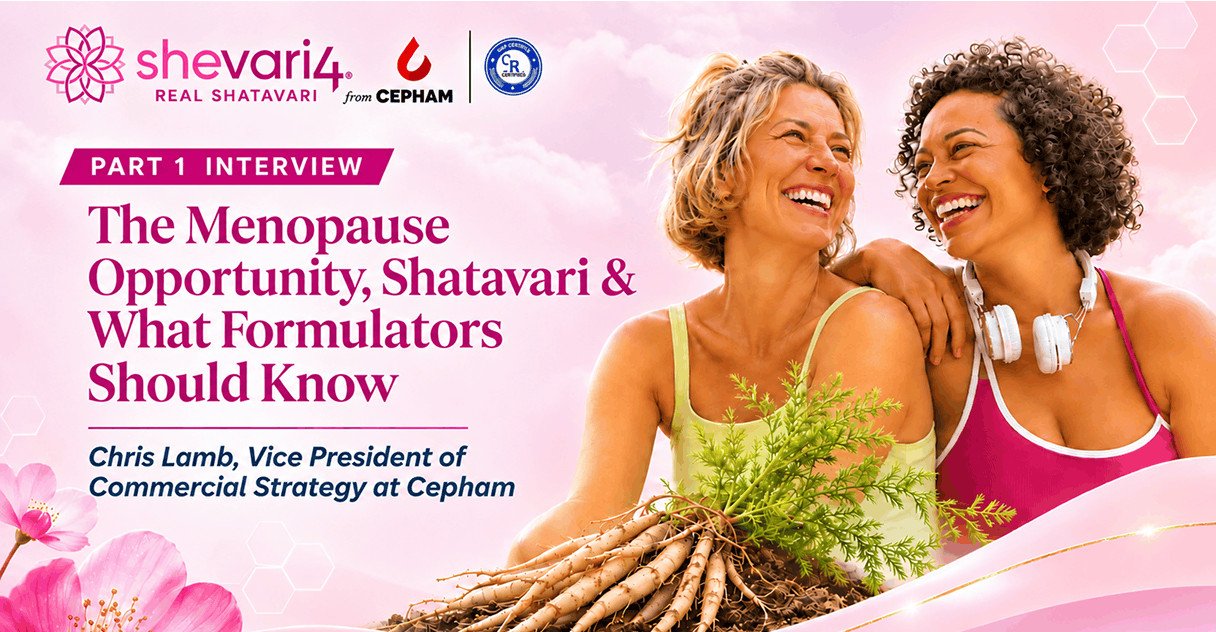
An interview with Chris Lamb of Cepham
By Paul Burton, NXT Ingredients®
Introduction
At the close of Day 3 at SupplySide Global, NXT Ingredients® sat down with Chris Lamb,Vice President of Commercial Strategy at Cepham, to discuss the growing opportunity in menopause support, what brands and formulators are looking for in the category, and why Shatavari is gaining increased attention as a formulation option.
In Part 1 of our conversation, Lamb shares his perspective on where the menopause market is heading, how product development is evolving, and what formulators should understand about Shatavari, Shatavarins and standardization when evaluating ingredients for the next generation of menopause-support products.
NXT: Coming out of SupplySide Global, what stood out to you most about the level of interest in women’s health and menopause support this year?
Chris Lamb: What stood out to me most was that women’s health, and
menopause in particular, no longer felt like a niche conversation. There was a much broader level of interest from brands looking at how they can support women through perimenopause, menopause, and healthy aging.
What was also encouraging was the depth of the conversations. People weren’t simply asking, ‘What ingredient do you have for menopause?’ They were interested in the science, the mechanism, clinically relevant outcomes, and how a product can offer something differentiated. To me, that signals that the category is maturing. Women are looking for solutions that address their experience more holistically, and brands are recognizing that they need credible, evidence-backed products to meet that demand.
NXT: From the conversations you had with brands, formulators and manufacturers at the show, what types of menopause products or formulation strategies seemed to be getting the most attention?
Chris Lamb: One thing that really stood out in our conversations was that brands are becoming much more sophisticated about how they evaluate ingredients. A higher standardization number doesn’t necessarily mean a better ingredient. With SheVari4, for example, we standardize specifically to 5% Shatavarin IV, rather than simply promoting a larger number like 10%, 15% or 20% total shatavarins. For us, it’s about the identity and relevance of what you’re standardizing to,not just how big the number looks on a marketing sheet.
The same philosophy applies to the science. We don’t want to design studies simply to ask, ‘Did symptoms improve?’ We also want to understand why they improved. That means looking beyond symptom scores and investigating relevant physiological and mechanistic measures that can help us understand what may be driving the observed benefits.
I think that became especially important at this year’s show because brands, formulators and manufacturers are challenging the science more than they have in the past, and frankly, they should. There’s skepticism around aggressive marketing claims, and customers want to know that the ingredient is well characterized, the study design is credible and the results are real and meaningful. We see that as a positive development because it puts the focus back on specificity, transparency and good science.
NXT: Did those conversations reinforce for you why Shatavari is becoming more relevant to brands developing or upgrading products in this category?
Chris Lamb: Shatavari isn’t new. Brands and developers have known about it for years, if not decades. Many told us they were really waiting for the science to catch up with the traditional use and for the ingredient to become more flexible in modern formulations.
With SheVari4, we’ve tried to address both, but there’s a third element that I think is becoming equally important: transparency. Brands want to see the data behind the science, understand what is actually being measured and have the ability to work with a qualified third-party lab they trust. They’rebecoming more skeptical when they’re directed toward only one specific laboratory, and I think that skepticism is healthy.
At the same time, consumers don’t want to be limited to capsules, so versatility matters more than ever. The opportunity for Shatavari today isn’t about rediscovering an old ingredient. It’s about bringing it forward with better science, meaningful standardization, greater transparency and the formulation flexibility today’s brands and consumers expect.
And honestly, it’s refreshing. Brands are asking harder questions and looking more closely at the data. That ultimately makes the category stronger.
NXT: Clearly the menopause-support category has been growing rapidly. So, what is driving increased brand and consumer attention to this space?
Chris Lamb: I think a big part of it is that women are simply talking about menopause much more openly than they were even five or ten years ago. There is much more awareness of what women are experiencing and, as aresult, much more demand for products that address those needs.
From the industry side, brands are recognizing that this is a very large group of consumers who historically haven't had nearly as many targeted Nutritional products available to them as they should have. So you're seeing more product development, more research and frankly more competition coming into the space.
NXT: As the category expands, are you seeing brands gravitate toward broad, all-in-one menopause formulas, or toward more targeted products addressing specific concerns such as hot flashes, sleep, mood, cognition, vaginal health and sexual wellness?
Chris Lamb: We're seeing both. There is still a place for a comprehensive menopause formula because most women aren't dealing with just one symptom. But I also think you're going to continue seeing more products built around specific needs.
Someone may be primarily concerned about hot flashes and night sweats, while another woman may be having more difficulty with sleep, mood or vaginal discomfort. That creates an opportunity for brands to be much more precise about who the product is for and what they're trying to accomplish with the formula.
NXT: Do you see the opportunity extending beyond menopause itself, with brands developing products specifically for Pre-menopause, Perimenopause and Post-menopause?
Chris Lamb: Definitely. I don't think the category should be viewed as simply “menopause.” It’s also very personalized. For some women symptoms of Pre-menopause can begin years before a woman reaches perimenopause, and what she needs at that stage may be very different from what she needs five or ten years later. We're beginning to see brands think about that entire transition rather than treating every woman over a certain age as the same consumer. From a formulation standpoint, that gives you a lot more room to develop products around where a woman actually is in that process.
NXT: Are women becoming more sophisticated in what they expect from menopause-support products, and is that changing what brands are asking ingredient suppliers and formulators to deliver?
Chris Lamb: Yes, and I think brands are becoming more sophisticated as well. It's not enough anymore to put a few familiar women's-health ingredients together and assume that's going to differentiate the product.
We get much more detailed questions today. What was the ingredient standardized to? What dose was used in the clinical work? Was the actual commercial ingredient studied, or are we talking about research on the botanical generally? How is the material tested?
Those are good questions. They force ingredient suppliers to do a better job of substantiating what they're selling.
NXT: Against that backdrop, why has Shatavari emerged as an ingredient that supplement brands, product-development teams and formulators should be paying attention to?
Chris Lamb: Shatavari has been used in Ayurveda for women's health for a very long time, so the botanical itself isn't new. What's different today is that we're getting much better substantiation through science and standardization of Shatavari extracts more sophisticated. A bigger number does not always mean more effective
That's important because a formulator doesn't really buy “Shatavari” in the abstract. They're buying a particular extract with a particular specification and dose. As the clinical research has developed, we've also started seeing data around menopausal concerns such as hot flashes, sleep, mood and vaginal health.
I think that's why Shatavari is becoming much more interesting to modern product developers. The conversation is moving beyond traditional use and into what is actually in the extract, how it is standardized and what, and how, has actually been studied.
NXT: Shatavari has centuries of use in Ayurvedic medicine. What has changed in the science that has made this traditional botanical increasingly relevant to modern menopause formulations?
Chris Lamb: The traditional use gives Shatavari an interesting history, but that isn't enough for most product-development teams today. What's changed is our ability to characterize the extract much more precisely and then study standardized material in human subjects.
We're getting better analytical work around the compounds in Shatavari, particularly the Shatavarins, and we're seeing human studies looking at outcomes that are directly relevant to women going through menopause. That gives formulators something much more concrete to evaluate than simply saying a botanical has been used traditionally for women's health.
I think that's the shift. We're moving from traditional knowledge toward understanding what is in the extract, what dose is being used and what happens when that defined material is actually studied. More importantly we are discovering how and which impact the body.
NXT: Where do you see Shatavari fitting within a finished product? Is it better viewed as the foundation of a menopause formula, a complementary ingredient, or can it play both roles?
Chris Lamb: If the product is centered around menopausal symptoms such as hot flashes, sleep or mood, a clinically studied Shatavari can certainly play a major role in the formula. But menopause is broader than any one group of symptoms, so there are also very good reasons to combine it with ingredients addressing areas such as bone health, cognition, stress or metabolic health. “Brain Fog” is something I hear brands asking about.
That's one reason dose becomes important. Once you start building a multi-ingredient formula, every milligram matters. You want meaningful amounts of the ingredients you're using without ending up with an impractical serving size.
NXT: When formulators begin comparing commercial Shatavari ingredients, are they essentially looking at different versions of the same botanical, or can sourcing, extraction and standardization create meaningful differences between products?
Chris Lamb: They can be very different. Saying an ingredient is Shatavari really only tells you where the conversation starts.
You still have to ask what part of the plant is being used, how it's extracted, what the finished extract is standardized to and how that specification is being verified. Two suppliers can both sell Asparagus racemosus root extracts and still give a formulator very different materials.
That was part of our thinking with SheVari4®. We didn't want to simply offer another Shatavari powder and put a brand name on it. We wanted a defined extract where we could identify a specific Shatavarin we considered important, standardize around it, and then evaluate that material clinically. A reference standard and a validated method allows the formulator to ensure the material they are using is exactly the same as what was studied for safety and efficacy.
NXT: You mentioned SheVari4® as an example of a more defined approach to Shatavari. What was Cepham specifically trying to accomplish when developing the ingredient?
Chris Lamb: One of the things we wanted was greater specificity. There are multiple Shatavarins in the plant, and rather than only giving total-Shatavarin number, we chose to specifically standardize SheVari4® to a minimum of 5%Shatavarin IV.
We also wanted it to be practical for formulators. The finished ingredient is used at 100 mg, and the extract has a neutral, maskable taste, so it doesn't take over the formula either from a dosage standpoint or from a sensory standpoint.
But ultimately the goal was to create a Shatavari extract with a clearly defined specification and then build clinical work around that same standardized material. That connection between the ingredient you're buying and the ingredient that was studied is very important to us.
NXT: We hear the term “Shatavarins” frequently when discussing standardized Shatavari extracts. What exactly are Shatavarins, and why should formulators understand them?
Chris Lamb: Shatavarins are a family of steroidal saponins naturally found in Shatavari, and they're considered some of the plant's important bioactive compounds.
The important thing for formulators is that “Shatavarins” isn't one single compound. There are different Shatavarins within the plant. So when an extract is described only by a percentage of total Shatavarins, you're looking at the combined amount of that family of compounds. That doesn't necessarily tell you how much of a particular Shatavarin is present.
That's why I think the conversation around standardization is becoming more important. A formulator should understand not only how much total material is being measured, but also what the supplier is actually standardizing for and why.
NXT: With multiple Shatavarins naturally occurring within the plant, do they all appear to have the same biological significance, or are researchers beginning to understand meaningful differences among them?
Chris Lamb: I don't think we should assume they're all interchangeable. They're related compounds, but they have different structures, and researchers are beginning to look more closely at individual Shatavarins rather than treating them simply as one group.
Shatavarin IV in particular has received quite a bit of attention, but I would be careful about saying one Shatavarin is universally “better” than another. I think the more important point for a formulator is that we're getting to a place where we can be much more specific about what is actually present in an extract and what the research has been conducted on.
That is a much more useful conversation than simply looking at one large total-Shatavarin number.
NXT: From a product-development standpoint, how important is it to know not simply that an extract contains Shatavarins, but which Shatavarins are actually being measured and standardized?
Chris Lamb: I think it’s very important, particularly as the category becomes more sophisticated.
If I’m developing a product, I want to know what the specification really means. If the specification says 10% or 15% total Shatavarins, that tells me the combined amount of the Shatavarin family, but it doesn’t necessarily tell me how much of any one individual Shatavarin is present.
For example, SheVari4® is standardized to a minimum 5% Shatavarin IV specifically. So the formulator knows that at least 5% of the extract is that specific Shatavarin, rather than simply knowing the combined percentage of all Shatavarins.
That gives you another level of specificity when you’re evaluating the ingredient and comparing the specification with the material that was actually studied.
NXT: Many Shatavari ingredients promote a percentage of “total Shatavarins.” Does a higher total-Shatavarin percentage necessarily mean a more relevant or more effective ingredient?
Chris Lamb: Not necessarily. A higher number may tell you that the extract contains a larger combined amount of Shatavarins, but by itself it doesn't tell you which Shatavarins are present at what levels, and it certainly doesn't tell you how the ingredient performed clinically.
I think this is where formulators need to be careful with percentage comparisons. It's very easy to look at 15% and assume it must be better than 5%, but if one number represents total Shatavarins and the other represents a specific Shatavarin, you're really comparing two different specifications.
For me, the more useful questions are what exactly is being standardized, why that marker was selected, what dose was studied and whether the commercial ingredient matches the material used in the research.
NXT: So, SheVari4® takes a different approach by standardizing specifically to a minimum 5% Shatavarin IV. Why did Cepham choose to focus on Shatavarin IV rather than simply maximizing a total-Shatavarin number?
Chris Lamb: We wanted SheVari4® to have a very clearly defined specification. Shatavarin IV is one of the important bioactive saponins found in Shatavari and has received significant scientific attention, so rather than just reporting a combined Shatavarin number, we chose to guarantee a minimum level of Shatavarin IV itself.
That doesn't mean we've removed the other naturally occurring Shatavarins. SheVari4® remains a full-spectrum extract. What we're doing is putting a specific specification around Shatavarin IV and verifying that through validated analytical methods.
For us, that gives the formulator something very concrete to work with, and it also gives us a defined material that we can carry forward into the clinical research.
NXT: How should a formulator think about the difference between an extract standardized to total Shatavarins and one standardized to a defined amount of a specific Shatavarin?
Chris Lamb: I would look at them as two different pieces of information.
Total Shatavarins tells you how much of the broader Shatavarin family is present in the extract. A specific standardization tells you that a defined amount of one particular Shatavarin is guaranteed to be there.
Neither number should really be viewed in isolation. The specification has to be considered together with the clinical research, the dose and the analytical methods being used to verify the ingredient.
That's why I always come back to the same question: what exactly did you study, and is that the same material I'm going to be putting into my finished product?
NXT: Moving away from chemistry for a moment, which menopausal symptoms does the current research on standardized Shatavari suggest may be most responsive to this type of ingredient?
Chris Lamb: The research is pointing to several symptom areas that are especially relevant in menopause, including hot flashes and night sweats, sleep disruption, mood-related symptoms, vaginal dryness and sexual wellness.
What makes that interesting is that menopause rarely presents as a single issue. A woman may be dealing with vasomotor symptoms, poor sleep and mood changes at the same time, so an ingredient that has been studied across several of those areas can be very useful from a formulation standpoint.
That said, I think it’s important to look at the specific standardized extract that was studied, because you can’t assume every Shatavari ingredient willdeliver the same results simply because they come from the same botanical.
NXT: How important is it to distinguish between general published research on Shatavari and clinical research performed on the exact standardized commercial ingredient a brand is considering?
Chris Lamb: I think that distinction is extremely important. There’s nothing wrong with looking at the broader Shatavari literature. It helps establish the history of the botanical and gives you a sense of where the science is going. But if I’m a brand putting an ingredient into a finished product, I want to know whether the material I’m buying is actually the same standardized extract that was used in the clinical work.
That’s where you start getting much more confidence in the dose, the specification and the relevance of the results to the finished formula.
NXT: When ingredient-specific clinical research is available, what does that allow a brand or formulator to understand that broader botanical research may not?
Chris Lamb: It closes a lot of the gaps.
If you only have research on Shatavari generally, you may know the botanical has potential, but you still don’t necessarily know how the commercial extract was made, what it was standardized to or what dose was actually effective.
With ingredient-specific research, you can connect those pieces. You know the extract, the specification, the dose and the population that was studied. From a product-development standpoint, that’s much more useful because you’re not having to make as many assumptions.
NXT: Let’s get back to SheVari4®, it has been clinically studied at 100 mg per day. What did that research show in areas such as hot flashes and sweating, sleep, mood-related symptoms, vaginal dryness and sexual wellness?
Chris Lamb: In the initial, SheVari4® study, 60 women received either 100 mg of SheVari4® or placebo for eight weeks, and we saw a significant reduction in overall menopausal symptom severity by four weeks, with further improvement by eight weeks. Later research investigated what is happening below the surface. We looked at a broad spectrum of hormones. For example estrogen increases correspond to improvement in hot flashes. Also study participants felt less stressed, and we also see reduction in cortisol.
The strongest responses included hot flashes and sleep, but the improvements weren’t limited to those areas. The study looked across somatic, psychological and urogenital symptoms, so we also saw movement in areas related to mood and sexual or vaginal health. I think that broader response is important because, as we discussed earlier, most women aren’t dealing with just one menopausal symptom.
NXT: When customers choose SheVari4® as the hero ingredient in a menopause formula, what reasons do you hear most often?
Chris Lamb: The reasons we hear most often tend to come back to three things. First is the robust clinical work. Brands want an ingredient they can build a meaningful menopause story around, and SheVari4® has been studied directly in women at the same 100 mg dose they can actually use in the finished product. We know Shatavari can make you feel better, we know how, and why, Shevari4 makes improvements.
Second is safety. An important part of our work is to ensure we are providing an effective, and SAFE, product. Safety is incorporated into every study we do
And the third is the dose. At 100 mg, it gives product-development teams a lot of flexibility. They can make SheVari4® the hero ingredient and still have room to build around it with other actives depending on whether they want to address sleep, stress, cognition, bone health or other aspects of the menopause experience.
All of above is enabled with validated testing method using a commercially-available standard. SheVari4® is standardized specifically to a minimum 5% Shatavarin IV, so the formulator knows exactly what they are buying rather than simply seeing a total-Shatavarin number.
I think that combination—a defined extract, ingredient-specific clinical research and a practical dose—is what tends to resonate most with brands. We also produce a sustainable product using regenerative agriculture. This ensure Shatavari will be around for another 1000 years
Conclusion
What becomes clear from the conversation is that evaluating Shatavari for a menopause formulation requires looking beyond the botanical name—or even a headline percentage of total Shatavarins. Standardization, the specific bioactives being measured, the clinically studied dose and whether the commercial ingredient matches the material used in the research all matter.
In Part 2, we’ll take a closer look at SheVari4® itself, including why Cepham chose to standardize specifically to Shatavarin IV, what its clinical research tells us about menopausal symptom support, the formulation advantages of its 100 mg dose, and the quality and testing considerations brands should understand when evaluating the ingredient.